There are plenty of ways to bet on the NFL. Spreads. Totals. Player props. Same-game parlays. Teasers. Live betting. Futures. And, of course, the moneyline.
With so many choices available every Sunday, it is easy for a bettor to confuse more bets with better betting.
What if the opposite were true?
The idea behind The ONE Thing by Gary Keller is simple: instead of trying to accomplish everything at once, identify the one thing that matters most and concentrate your effort there. Applied to NFL betting, that philosophy creates a much cleaner approach.
The goal isn’t to predict every game on the schedule. It isn’t to turn every Sunday into a massive parlay. And it certainly isn’t to chase losses when a favorite unexpectedly loses.
The goal is to develop one repeatable betting process: find opportunities worth considering, get the best available price, manage your bankroll, and stay disciplined.
For this approach, straight NFL moneyline bets are the foundation. Three-pick maximum moneyline parlays can have a place, but they remain a small side strategy rather than the engine of the bankroll.
The ONE Thing in NFL Betting: Focus on the Price
If there is one concept a bettor should take from this strategy, it is this: don’t just ask who will win; ask whether the price makes the bet worthwhile.
That distinction can completely change the way you look at an NFL betting board.
Imagine you believe Team A has a 58 percent chance of winning. At first glance, that sounds like a team worth backing. But now consider the price.
- At -125, the market break-even percentage is approximately 55.6 percent.
- At -140, it is approximately 58.3 percent.
- At -150, it is 60 percent.
It is the same football team, but the betting proposition changes as the price changes.
That is why a disciplined moneyline bettor doesn’t simply circle the team they think will win. They evaluate the matchup, estimate the probability of winning, and then compare that assessment with the price being offered.
A good team isn’t automatically a good bet
This is one of the easiest mistakes for newer bettors to make. A team can be better than its opponent and still be a poor wager at a particular moneyline.
Suppose a powerhouse is playing a struggling opponent. The favorite might have an excellent chance to win, but if the sportsbook requires you to lay -300, you need to win approximately 75 percent of the time just to break even over the long run at that price.
The question therefore becomes more sophisticated than, “Who wins?”
The better question is, “Is the price being offered consistent with the probability I believe this team has of winning?”
Start With a $2,500 NFL Betting Bankroll
A betting strategy should begin with bankroll management, not with a particular team.
Consider a bettor starting with a hypothetical $2,500 bankroll. Rather than deciding wager sizes emotionally, that bettor can establish a unit system before the first bet is placed.
A straightforward starting point is:
1 unit = $25, or 1 percent of the bankroll.
That gives the bettor a consistent measuring stick. A $25 wager is one unit. A $50 wager is two units. The dollar amount can gradually change as the bankroll changes.
Why units make betting easier to manage
Units separate the betting decision from the emotional impact of individual dollar amounts.
Instead of saying, “I lost $50,” you can say, “I lost two units.” Over time, that makes it easier to compare performance across weeks, seasons and different bankroll sizes.
It also discourages the temptation to make one huge wager simply because you feel unusually confident about a particular game.
Think in percentages, not paychecks
A $2,500 bankroll shouldn’t be treated like a checking account. The money is there to support a defined betting strategy, and the bettor should only use money they can afford to lose.
The objective is not to make the biggest possible bet on Sunday. The objective is to keep enough capital available to continue making decisions when the inevitable losing streak arrives.
Make Straight NFL Moneyline Bets the Foundation
If simplicity is the goal, straight moneyline bets are a natural place to begin.
A straight moneyline bet has one primary requirement: the team you select must win the game.
There is no need to predict the margin of victory. There is no requirement for a certain number of points. You simply select the winner and accept the price attached to that selection.
Why straight bets deserve the biggest share of attention
Straight bets are easier to analyze and easier to evaluate over a meaningful sample.
- You can track your win-loss record.
- You can track your return on investment.
- You can record the exact odds you received.
- You can compare your price with the closing price.
- You can identify whether your process is actually producing value.
Most importantly, straight bets allow you to determine whether your handicapping process works before adding additional complexity.
That fits the ONE Thing philosophy perfectly: master the primary process before piling on additional strategies.
Shop for the Best NFL Moneyline
Once you have decided that a team deserves consideration, there is another important step: shop for the best price.
Imagine five sportsbooks are offering the same NFL team at:
- -140
- -135
- -130
- -145
- -125
If you have already decided you want to bet that team, taking -125 instead of -145 gives you a better price on the exact same outcome.
That difference might not look enormous on one Sunday. Over dozens or hundreds of wagers, however, consistently obtaining better prices can materially affect results.
Separate the pick from the price
This creates two separate questions in your process:
Question one: Do I believe this team has enough probability of winning to consider a bet?
Question two: What is the best moneyline available?
Those questions should not be confused.
A team can qualify for consideration at -125 and become a pass at -155. The team hasn’t changed. The price has.
When Should You Increase Your NFL Bets?
One of the most dangerous moments for a bettor can come immediately after a winning streak.
Five straight wins can create the feeling that you’ve figured everything out. That feeling can quickly lead to larger wagers, and larger wagers can turn one losing Sunday into a significant bankroll setback.
A better approach is to let the bankroll itself determine when your unit size changes.
A simple bankroll-based example
- $2,500 bankroll → 1 unit = $25
- $3,000 bankroll → 1 unit = $30
- $3,500 bankroll → 1 unit = $35
- $4,000 bankroll → 1 unit = $40
- $5,000 bankroll → 1 unit = $50
The exact percentages can vary depending on the bettor’s risk tolerance, but the principle remains the same: scale gradually instead of chasing the scoreboard.
Don’t increase because you’re hot
A winning streak doesn’t guarantee another win.
Likewise, a losing streak doesn’t mean a winner is “due.” Football games contain enormous amounts of uncertainty, and even strong analysis can produce losing results.
Your bet size should therefore be determined by your predetermined bankroll rules, not by whether you are feeling lucky that afternoon.
What Happens When the Bankroll Drops?
Bankroll management isn’t only about knowing when to increase your wager. It also means knowing when to scale back.
If your $2,500 bankroll falls to $2,250, a 1 percent unit would now be $22.50 instead of $25.
That may not sound like a dramatic difference, but the purpose is important. Scaling the wager with the bankroll prevents a losing stretch from becoming even more damaging.
And one rule should be nearly universal: never chase losses.
Turning a $25 loss into a $50 wager, then $100, then $200 because you want to “get it back” isn’t a betting strategy. It’s an emotional reaction.
The Occasional Three-Pick NFL Moneyline Parlay
Parlays are entertaining because the potential payout can look dramatically larger than a straight bet. But that potential payout comes with additional risk.
For this strategy, the line is drawn at three picks maximum.
That doesn’t mean every betting week requires a three-team parlay. In fact, quite the opposite.
The three-pick parlay should be viewed as an occasional secondary wager rather than the foundation of the bankroll.
Why limit parlays to three teams?
Every additional leg introduces another outcome that must go your way.
Imagine you believe three teams have individual win probabilities of 70 percent, 68 percent and 65 percent. If those outcomes were independent, the simplified combined probability would be roughly 31 percent.
In other words, three teams can each look relatively attractive individually while the combined parlay remains much harder to hit.
That’s why a three-pick maximum creates a useful discipline: don’t turn every Sunday into a lottery ticket.
Keep the parlay stake small
With a $2,500 bankroll, a $5 or $10 three-pick parlay represents a very small percentage of the bankroll.
For example:
- $5 parlay = 0.2 percent of bankroll
- $10 parlay = 0.4 percent of bankroll
- $15 parlay = 0.6 percent of bankroll
A bettor might establish a rule that straight bets receive the majority of the betting capital while occasional three-pick parlays receive only a small amount.
The exact amount is a personal risk decision. The important part is establishing the limit before the games begin.
Don’t Force the Third Leg
One of the most important parlay rules is also one of the simplest: you don’t have to make a three-team parlay.
Suppose you identify two moneylines you genuinely like. Then you scan the rest of Sunday’s schedule and can’t find another selection that meets your criteria.
Leave it at two—or don’t make the parlay at all.
Adding a third team simply because the sportsbook offers a bigger payout defeats the purpose of having a disciplined process.
Analyze every leg as if it were a straight bet
A useful test is this:
“Would I be comfortable considering this team as a standalone moneyline bet?”
If the answer is no, why is the team suddenly worthy of being part of a parlay?
The parlay shouldn’t be used to disguise a questionable selection.
Build a Betting Journal
If you want to know whether your NFL betting strategy is actually working, keep records.
Memory is a terrible betting database. Bettors tend to remember the dramatic wins and the painful losses while forgetting the ordinary games in between.
What to track
- Date
- Game
- Team selected
- Moneyline price
- Sportsbook
- Bet size
- Result
- Closing moneyline
- Bankroll after the bet
Track straight bets and parlays separately.
After enough wagers, you may discover that your straight moneylines are performing differently from your parlays. That information is valuable because it allows you to make decisions based on evidence rather than emotion.
Don’t Judge Your Strategy After 10 Bets
Ten bets can tell you what happened. They cannot tell you everything about whether your process is sustainable.
That’s where sample size becomes important.
A bettor can go 8-2 over a short stretch while benefiting from favorable variance. Another bettor can go 3-7 while making several decisions that were reasonable at the prices available.
That doesn’t mean results don’t matter. They obviously do. It means results should be examined alongside the process that produced them.
Look beyond the win-loss record
After 50 to 100 bets, start asking deeper questions:
- What was my return on investment?
- What average moneyline price did I bet?
- How often did I get a better closing price?
- How much did parlays contribute to the results?
- Did I consistently follow my bankroll rules?
- How often did I make bets simply because I wanted action?
Those answers can reveal much more than a simple 62-38 record.
The NFL Betting Checklist
Before placing a straight moneyline bet, run through the same checklist every time.
Before a straight bet
- Do I have a clear reason for liking this team?
- Did I examine the current moneyline?
- Did I compare available prices?
- Does my estimated probability justify the price?
- Is the wager within my bankroll rules?
- Am I betting because of analysis rather than emotion?
Before a three-pick parlay
- Would I consider each team individually?
- Does each leg have a legitimate reason behind it?
- Did I check the available prices?
- Is the stake small enough?
- Am I forcing a third selection?
If a bet doesn’t pass the checklist, PASS is a perfectly legitimate betting decision.
What the ONE Thing Means on NFL Sunday
The beauty of a simplified betting strategy is that it changes what you’re looking for on Sunday morning.
Instead of asking, “What can I bet?” you’re asking, “What deserves my money?”
Instead of trying to predict every game, you’re searching for a small number of opportunities that fit your rules.
Instead of increasing your wager because you’re on a six-game winning streak, you follow your bankroll system.
Instead of adding a seventh leg because the payout looks exciting, you stop at three—or pass entirely.
And instead of judging yourself by whether every pick wins, you evaluate whether you followed a process designed to produce better decisions over a large sample.
Looking for NFL Picks?
Some bettors enjoy doing all of the research themselves. Others want technology to help organize the information and generate betting picks.
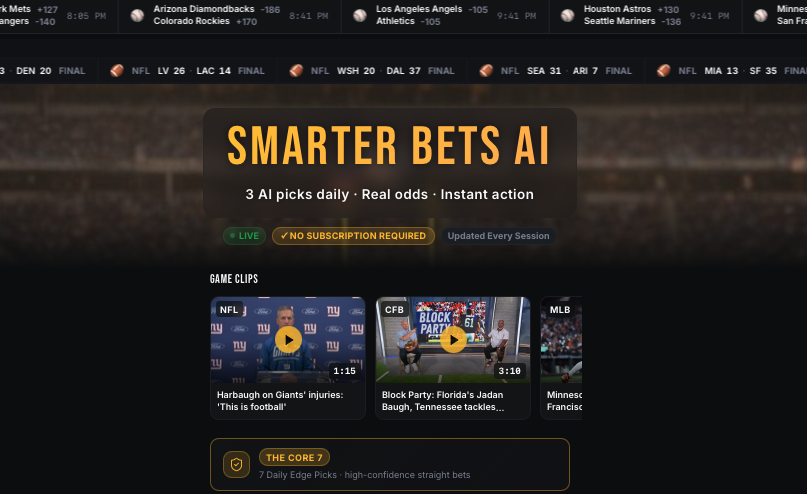
If you’re looking for NFL picks or want another tool to complement your own research, you can check out Smarter Bets.
The important distinction is that a pick should be treated as information to evaluate—not a guarantee. No app, model, analyst or handicapper can eliminate the uncertainty that comes with sports betting.
Use the information, compare it with your own process, consider the price, and make your own decision.
Frequently Asked Questions About NFL Betting
What is the best way to start betting on NFL moneylines?
Start with a defined bankroll and consistent unit size rather than trying to maximize individual wagers. A $2,500 hypothetical bankroll, for example, could use $25 as one unit. Focus on straight moneyline bets, record every wager and evaluate your results over a meaningful sample.
How much should I bet on an NFL moneyline?
There is no universal amount that is right for every bettor. A conservative framework is to use a small percentage of the bankroll per wager, such as 1 percent as a starting unit. The key is consistency. A bettor should never risk money they cannot afford to lose or dramatically increase wagers because of a winning or losing streak.
Are straight bets better than NFL parlays?
They serve different purposes. A straight bet requires one selection to win, while a parlay requires every selection to win. For a strategy focused on simplicity and tracking performance, straight bets can serve as the foundation, while small, occasional parlays can remain a secondary option.
How many teams should be in an NFL moneyline parlay?
This strategy caps parlays at three selections. The limit isn’t a guarantee of success; it is a discipline designed to prevent the bettor from continually adding legs simply to increase the potential payout.
When should I increase my NFL bet size?
Consider increasing your unit size when the bankroll has grown according to a predetermined percentage-based system, rather than because of a short winning streak. Likewise, reduce your unit when the bankroll falls. This keeps wager size connected to the amount of capital available.
Should I bet every NFL game?
No. One of the most valuable decisions a bettor can make is deciding not to bet. If a game doesn’t meet your criteria or the available price isn’t attractive enough, passing is part of the strategy. You don’t get paid for the number of bets you make; the goal is to make decisions that fit your process.
The Bottom Line: Find Your One Thing
NFL betting doesn’t need to become a complicated collection of dozens of markets and endless wagers.
A focused bettor can build an entire approach around a handful of principles: straight moneyline bets as the foundation, price awareness, disciplined bankroll management, careful record keeping and occasional three-pick maximum parlays.
Starting with $2,500 doesn’t mean trying to turn that bankroll into a fortune overnight. It means establishing a system that protects your capital while giving you enough time and data to find out whether your process actually has merit.
The ONE Thing philosophy provides a useful reminder: focus creates clarity.
On an NFL Sunday filled with dozens of opinions, predictions and betting opportunities, you don’t have to participate in all of them.
Find the opportunity that fits your process. Get the best price you can. Bet within your bankroll. Track what happens. Then do it again.
That’s the entire idea.
Not more bets.
Better focus.